← All Openings
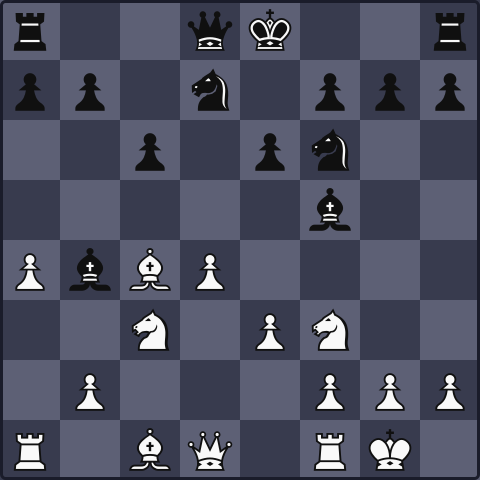
Slav Defense D10–D19
Solid queen's pawn with ...c6
Classical Slav
One of the most reliable responses to the Queen's Gambit. Black defends the d5 pawn with ...c6 while keeping the light-squared bishop free — a key advantage over the Queen's Gambit Declined where the bishop is often locked in.
The Slav is one of the most solid and respected defences to 1.d4. Black avoids the light-squared bishop problem of the QGD and gets a flexible, counterattacking position. It has been played by every world champion from Steinitz to Carlsen.
Lines
Classical Slav
intermediate
1. d4 d5
2. c4 c6
3. Nf3 Nf6
4. Nc3 dxc4
5. a4 Bf5
6. e3 e6
7. Bxc4 Bb4
8. O-O Nbd7
The most important Slav line. Black gives up the centre temporarily, develops the bishop to f5 before ...e6, and challenges White's position with a pin on Nc3.
2. c4 c6
3. Nf3 Nf6
4. Nc3 dxc4
5. a4 Bf5
6. e3 e6
7. Bxc4 Bb4
8. O-O Nbd7
Exchange Variation
beginner
1. d4 d5
2. c4 c6
3. cxd5 cxd5
4. Nc3 Nf6
5. Nf3 Nc6
6. Bf4 Bf5
7. e3 e6
White exchanges on d5 early, reaching a symmetrical pawn structure. With accurate play Black equalises comfortably, but White has slight piece activity.
2. c4 c6
3. cxd5 cxd5
4. Nc3 Nf6
5. Nf3 Nc6
6. Bf4 Bf5
7. e3 e6
Slav with ...Bf5 (4.e3)
beginner
1. d4 d5
2. c4 c6
3. Nf3 Nf6
4. e3 Bf5
5. Nc3 e6
6. Be2 Nbd7
7. O-O Bd6
A straightforward developing line. White delays playing Nc3 to avoid the dxc4 lines, and Black immediately posts the bishop on f5 — the classic Slav manoeuvre.
2. c4 c6
3. Nf3 Nf6
4. e3 Bf5
5. Nc3 e6
6. Be2 Nbd7
7. O-O Bd6
Modern Slav (3.Nc3 e5)
advanced
1. d4 d5
2. c4 c6
3. Nc3 e5
4. dxe5 d4
5. Ne4 Be6
6. Nf3 Bc5
7. Bg5 Qd5
Instead of developing the knight to f6, Black immediately counterattacks in the centre with ...e5. A sharp, modern approach that leads to dynamic positions with unbalanced material.
2. c4 c6
3. Nc3 e5
4. dxe5 d4
5. Ne4 Be6
6. Nf3 Bc5
7. Bg5 Qd5
Semi-Slav (4...e6)
advanced
1. d4 d5
2. c4 c6
3. Nf3 Nf6
4. Nc3 e6
5. Bg5 h6
6. Bxf6 Qxf6
7. e3 Nd7
8. Bd3 dxc4
9. Bxc4 g6
The Semi-Slav arises when Black plays ...e6 instead of ...dxc4, leading to a hybrid of the Slav and Queen's Gambit Declined. One of the most theoretically rich openings in chess.
2. c4 c6
3. Nf3 Nf6
4. Nc3 e6
5. Bg5 h6
6. Bxf6 Qxf6
7. e3 Nd7
8. Bd3 dxc4
9. Bxc4 g6
Chigorin Defense
intermediate
1. d4 d5
2. c4 c6
3. Nc3 Nf6
4. e3 e6
5. Nf3 Nbd7
6. Bd3 Bd6
The main line of Chigorin's Semi-Slav. Black develops with Bd6 and Nbd7, keeping the centre closed and preparing ...e5 at the right moment.
2. c4 c6
3. Nc3 Nf6
4. e3 e6
5. Nf3 Nbd7
6. Bd3 Bd6
Bogoljubow Variation
intermediate
1. d4 d5
2. c4 c6
3. Nc3 Nf6
4. e3 e6
5. Nf3 Nbd7
6. Bd3 Be7
Bogoljubow's system with Be7 instead of Bd6. More flexible but less aggressive, keeping options open for ...dxc4 or central breaks.
2. c4 c6
3. Nc3 Nf6
4. e3 e6
5. Nf3 Nbd7
6. Bd3 Be7
Romih Variation
intermediate
1. d4 d5
2. c4 c6
3. Nc3 Nf6
4. e3 e6
5. Nf3 Nbd7
6. Bd3 Bb4
The Romih Variation involves an early ...dxc4 and ...b5, gaining queenside space. A double-edged line where Black's queenside expansion can become a target.
2. c4 c6
3. Nc3 Nf6
4. e3 e6
5. Nf3 Nbd7
6. Bd3 Bb4
Semi-Slav Main Line
intermediate
1. d4 d5
2. c4 c6
3. Nc3 Nf6
4. e3 e6
5. Nf3 Nbd7
6. Bd3
The classical Semi-Slav main line. Black plays ...Qc7 and ...Nbd7, preparing ...e5 at the right moment while keeping the centre closed.
2. c4 c6
3. Nc3 Nf6
4. e3 e6
5. Nf3 Nbd7
6. Bd3