← All Openings
Sicilian Defense B20–B99
The sharpest reply to 1.e4
Open Sicilian
The most popular response to 1.e4 at every level. Black fights for the center asymmetrically with 1...c5, leading to unbalanced positions with winning chances for both sides.
The Sicilian Defense is the most combative response to 1.e4 and the statistically most successful for Black. It immediately creates an unbalanced position with winning chances for both sides. Playing the Sicilian forces you to develop sharp tactical skills and deep opening knowledge.
Lines
Open Sicilian
intermediate
1. e4 c5
2. Nf3 d6
3. d4 cxd4
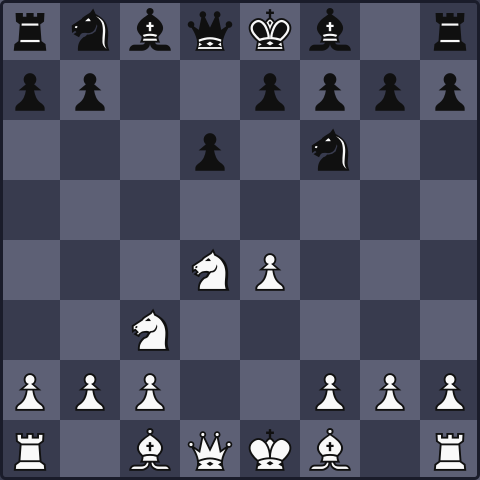
4. Nxd4 Nf6
5. Nc3
White plays d4, opens the center, and enters the most theoretically rich territory in chess. The branching point for Najdorf, Dragon, Scheveningen, and Classical.
2. Nf3 d6
3. d4 cxd4
4. Nxd4 Nf6
5. Nc3
Najdorf Variation
advanced
1. e4 c5
2. Nf3 d6
3. d4 cxd4
4. Nxd4 Nf6
5. Nc3 a6
5...a6 prevents Nb5 and Bb5+, and prepares queenside expansion. The favourite of Fischer, Kasparov, and countless world-class players.
2. Nf3 d6
3. d4 cxd4
4. Nxd4 Nf6
5. Nc3 a6
Dragon Variation
advanced
1. e4 c5
2. Nf3 d6
3. d4 cxd4
4. Nxd4 Nf6
5. Nc3 g6
Black fianchettoes the bishop to g7 for long-term diagonal pressure. One of the sharpest and most theoretically demanding openings in chess.
2. Nf3 d6
3. d4 cxd4
4. Nxd4 Nf6
5. Nc3 g6
Scheveningen Variation
intermediate
1. e4 c5
2. Nf3 d6
3. d4 cxd4
4. Nxd4 Nf6
5. Nc3 e6
Black builds a compact d6+e6 structure. Flexible and solid - Black can adapt to many White plans from this resilient pawn formation.
2. Nf3 d6
3. d4 cxd4
4. Nxd4 Nf6
5. Nc3 e6
Classical Variation
intermediate
1. e4 c5
2. Nf3 Nc6
3. d4 cxd4
4. Nxd4 Nf6
5. Nc3 d6
Black develops naturally with Nc6 before committing to a pawn structure. Flexible and solid, with good transposition options.
2. Nf3 Nc6
3. d4 cxd4
4. Nxd4 Nf6
5. Nc3 d6
Accelerated Dragon
intermediate
1. e4 c5
2. Nf3 Nc6
3. d4 cxd4
4. Nxd4 g6
5. Nc3 Bg7
Black fianchettoes without playing ...d6, keeping the option of ...d5 in one move. Avoids the Yugoslav Attack while retaining the powerful dragon bishop.
2. Nf3 Nc6
3. d4 cxd4
4. Nxd4 g6
5. Nc3 Bg7
Hyper Accelerated Dragon
intermediate
1. e4 c5
2. Nf3 g6
3. d4 cxd4
4. Nxd4 Bg7
5. Nc3 Nc6
Black plays ...g6 on move two before developing the knight to c6, reaching an Accelerated Dragon where Black has maximum flexibility in piece placement.
2. Nf3 g6
3. d4 cxd4
4. Nxd4 Bg7
5. Nc3 Nc6
Sveshnikov Variation
advanced
1. e4 c5
2. Nf3 Nc6
3. d4 cxd4
4. Nxd4 Nf6
5. Nc3 e5
6. Ndb5 d6
7. Bg5 a6
8. Na3
Black plays ...e5 to challenge the centre but accepts a backward d-pawn. One of the most fighting defences in chess - sharp, uncompromising, beloved by Leko and Topalov.
2. Nf3 Nc6
3. d4 cxd4
4. Nxd4 Nf6
5. Nc3 e5
6. Ndb5 d6
7. Bg5 a6
8. Na3
Kan Variation
intermediate
1. e4 c5
2. Nf3 e6
3. d4 cxd4
4. Nxd4 a6
Black plays ...a6 early to prevent Nb5 and Bb5+, keeping the position flexible. Can transpose into Scheveningen or Taimanov structures.
2. Nf3 e6
3. d4 cxd4
4. Nxd4 a6
Taimanov Variation
intermediate
1. e4 c5
2. Nf3 e6
3. d4 cxd4
4. Nxd4 Nc6
5. Nc3 Qc7
Black develops naturally with Nc6 and Qc7, preparing ...a6 and queenside expansion. A solid, flexible system that avoids the most forcing lines.
2. Nf3 e6
3. d4 cxd4
4. Nxd4 Nc6
5. Nc3 Qc7