← All Openings
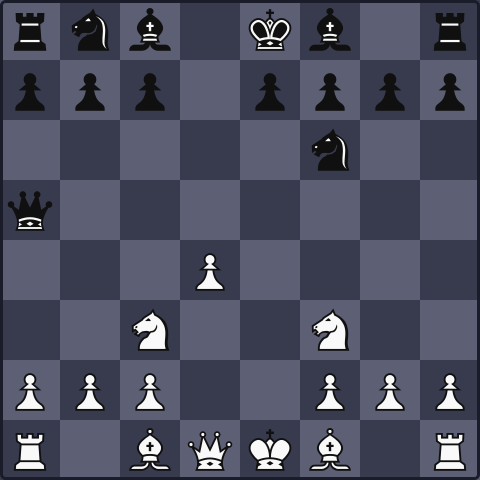
Scandinavian Defense B01
Immediate central challenge
Main Line (2...Qxd5)
Black immediately challenges the e4 pawn with 1...d5. After 2.exd5 Black can recapture with the queen or the knight. One of the oldest recorded openings in chess.
The Scandinavian is an easy-to-learn defence that immediately challenges White's centre with 1...d5. The ideas are straightforward: trade pawns, develop quickly, and castle. Fewer forcing lines than other defences, making it ideal for beginners and club players.
Lines
Main Line (2...Qxd5)
beginner
1. e4 d5
2. exd5 Qxd5
3. Nc3 Qa5
4. d4 Nf6
5. Nf3
Black recaptures with the queen. White chases it with Nc3 and Black retreats to a5. Active piece play at the cost of a slightly premature queen development.
2. exd5 Qxd5
3. Nc3 Qa5
4. d4 Nf6
5. Nf3
Modern Variation (2...Nf6)
beginner
1. e4 d5
2. exd5 Nf6
3. d4 Nxd5
4. Nf3 g6
Black recaptures with the knight instead of the queen, avoiding early queen exposure. Leads to solid, flexible positions.
2. exd5 Nf6
3. d4 Nxd5
4. Nf3 g6
Portuguese Gambit (3…Qd6)
beginner
1. e4 d5
2. exd5 Qxd5
3. Nc3 Qd6
Black retreats the queen to d6 instead of a5, keeping it more central and flexible. A solid alternative that avoids the heavily analysed 3…Qa5 lines.
2. exd5 Qxd5
3. Nc3 Qd6
Marshall Gambit
intermediate
1. e4 d5
2. exd5 Nf6
3. c4 c6
4. d4 cxd5
5. Nc3 e6
6. Bg5 Be7
White offers a queenside pawn to accelerate development. Black can accept but White gains active piece play and central control as compensation.
2. exd5 Nf6
3. c4 c6
4. d4 cxd5
5. Nc3 e6
6. Bg5 Be7
Icelandic Gambit
intermediate
1. e4 d5
2. exd5 Nf6
3. c4 e6
4. dxe6 Bxe6
5. d4 Bb4+
6. Nc3 Ne4
When White plays 3.c4, Black counter-sacrifices with 3...e6 to open lines and develop rapidly. A sharp and aggressive response that punishes timid play.
2. exd5 Nf6
3. c4 e6
4. dxe6 Bxe6
5. d4 Bb4+
6. Nc3 Ne4