← All Openings
Réti Opening A04–A09
Hypermodern central control
Main Line
White develops the knight to f3 and fianchettoes to control the centre from afar. Named after Richard Réti, a pioneer of the hypermodern school of chess in the 1920s.
The Réti Opening is the quintessential hypermodern opening - White controls the centre from a distance rather than occupying it directly. It leads to rich, strategic play where piece activity and flexibility trump pawn structure. A favourite of creative, positional players.
Lines
Main Line
intermediate
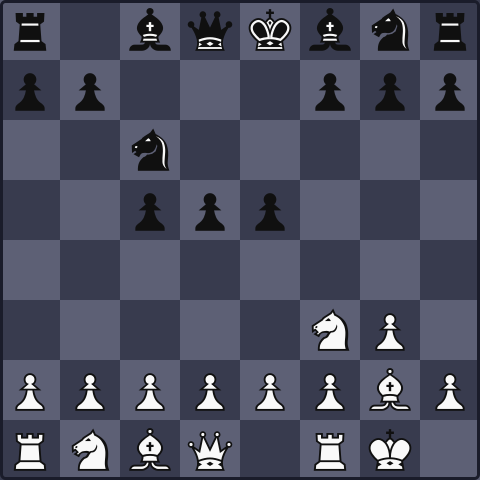
1. Nf3 d5
2. g3 c5
3. Bg2 Nc6
4. O-O e5
White fianchettoes and castles quickly. Black builds a large pawn centre that White will challenge from the flanks.
2. g3 c5
3. Bg2 Nc6
4. O-O e5
King's Indian Attack
beginner
1. Nf3 d5
2. g3 Nf6
3. Bg2 g6
4. O-O Bg7
5. d3 O-O
White sets up the King's Indian Attack - a reversed King's Indian structure. A system that can be used against many Black setups.
2. g3 Nf6
3. Bg2 g6
4. O-O Bg7
5. d3 O-O
Advance Variation (2…d4)
intermediate
1. Nf3 d5
2. c4 d4
Black advances the pawn to d4, gaining space and blocking White’s central influence. A combative response that leads to an immediate pawn structure fight.
2. c4 d4
Reti Gambit
advanced
1. Nf3 d5
2. c4 d4
3. b4 c5
4. bxc5 Nc6
5. d3 e5
6. Bb2 Bxc5
7. g3 Nf6
8. Bg2
When Black advances to d4, White sacrifices a pawn with b4 to open lines and develop quickly. An aggressive way to handle the Advance variation.
2. c4 d4
3. b4 c5
4. bxc5 Nc6
5. d3 e5
6. Bb2 Bxc5
7. g3 Nf6
8. Bg2
Nimzowitsch-Larsen Setup
intermediate
1. Nf3 d5
2. b3 Nf6
3. Bb2 g6
4. g3 Bg7
5. Bg2 O-O
6. O-O c5
7. e3 Nc6
White builds a double fianchetto with b3 and g3, controlling both long diagonals. A hypermodern system that emphasises piece activity over central pawn occupation.
2. b3 Nf6
3. Bb2 g6
4. g3 Bg7
5. Bg2 O-O
6. O-O c5
7. e3 Nc6