← All Openings
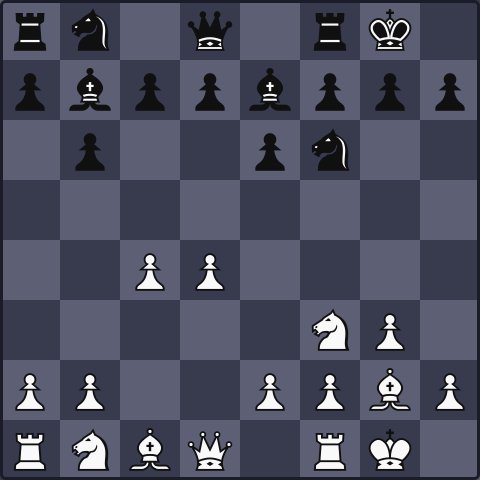
Queen's Indian Defense E12–E19
Hypermodern control of e4
Main Line
After 3.Nf3 (avoiding Nc3 which allows Nimzo-Indian), Black plays ...b6 and fianchettoes to control e4 from a distance. A sophisticated hypermodern defence.
The Queen's Indian is a sophisticated hypermodern defence that fights for control of the centre from the flanks. After 3.Nf3 (avoiding the Nimzo-Indian), Black plays ...b6 and fianchettoes to control e4 from a distance. It leads to subtle, strategic play for patient positional players.
Lines
Main Line
intermediate
1. d4 Nf6
2. c4 e6
3. Nf3 b6
4. g3 Bb7
5. Bg2 Be7
6. O-O O-O
Both sides fianchetto. White controls the centre from afar; Black's Bb7 contests the long diagonal. A sophisticated, strategically rich opening.
2. c4 e6
3. Nf3 b6
4. g3 Bb7
5. Bg2 Be7
6. O-O O-O
Petrosian System (4.a3)
intermediate
1. d4 Nf6
2. c4 e6
3. Nf3 b6
4. a3
White plays a3 to prevent ...Bb4+ and the Nimzo-style pin. A prophylactic move that keeps more options open.
2. c4 e6
3. Nf3 b6
4. a3
Kasparov Variation (4…Ba6)
advanced
1. d4 Nf6
2. c4 e6
3. Nf3 b6
4. g3 Ba6
Instead of fianchettoing with ...Bb7, Black develops the bishop to a6 to pressure the c4 pawn immediately. A sharp, aggressive line pioneered by Garry Kasparov.
2. c4 e6
3. Nf3 b6
4. g3 Ba6
Miles Variation (4.Bg5)
intermediate
1. d4 Nf6
2. c4 e6
3. Nf3 b6
4. Bg5 Bb7
5. Nbd2 Be7
6. e3 O-O
White pins the knight on f6 before committing to a fianchetto. This system leads to positions similar to the Rubinstein Nimzo-Indian but with Black's bishop on b7.
2. c4 e6
3. Nf3 b6
4. Bg5 Bb7
5. Nbd2 Be7
6. e3 O-O
Zincocinski Variation (4.Nc3)
intermediate
1. d4 Nf6
2. c4 e6
3. Nf3 b6
4. Nc3 Bb7
5. a3 d5
6. cxd5 Nxd5
7. e4
The Polovodin Gambit of the Zincocinski/Kasparov Variation. Black immediately contests the centre with ...d5, and White pushes e4 offering a pawn for rapid development and central control.
2. c4 e6
3. Nf3 b6
4. Nc3 Bb7
5. a3 d5
6. cxd5 Nxd5
7. e4
Queen's Indian, with e3
intermediate
1. d4 Nf6
2. Nf3 e6
3. e3 b6
4. Bd3 Bb7
5. O-O c5
6. c4
The classic e3 Queen's Indian. White plays a Colle-like setup with Bd3, avoiding the theoretical complexities of the g3 fianchetto.
2. Nf3 e6
3. e3 b6
4. Bd3 Bb7
5. O-O c5
6. c4
Queen's Indian, Bb4+ Line
intermediate
1. d4 Nf6
2. c4 e6
3. Nf3 Bb4+
4. Nbd2 b6
5. e3 Bb7
Black throws in an early Bb4+ before committing the pawn structure, forcing White to block with a piece and possibly weaken the queenside.
2. c4 e6
3. Nf3 Bb4+
4. Nbd2 b6
5. e3 Bb7
Spassky System
intermediate
1. d4 Nf6
2. c4 e6
3. Nf3 b6
4. e3
Boris Spassky's favourite treatment of the Queen's Indian. Black plays an early d5 to stake a claim in the centre, leading to a symmetrical pawn structure.
2. c4 e6
3. Nf3 b6
4. e3
Averbakh Variation
intermediate
1. d4 Nf6
2. c4 e6
3. Nf3 b6
4. e3 Bb7
5. Bd3 c5
6. O-O Be7
7. b3 O-O
8. Bb2 cxd4
9. Nxd4
The Averbakh Variation sees Black play an early c5, challenging White's centre immediately. Leads to open, tactical play.
2. c4 e6
3. Nf3 b6
4. e3 Bb7
5. Bd3 c5
6. O-O Be7
7. b3 O-O
8. Bb2 cxd4
9. Nxd4
Spassky System (c5 line)
intermediate
1. d4 Nf6
2. c4 e6
3. Nf3 b6
4. e3 Bb7
5. Bd3 c5
An offshoot of the Spassky System where Black plays c5 early, leading to a more fluid central structure compared to the d5 line.
2. c4 e6
3. Nf3 b6
4. e3 Bb7
5. Bd3 c5