← All Openings
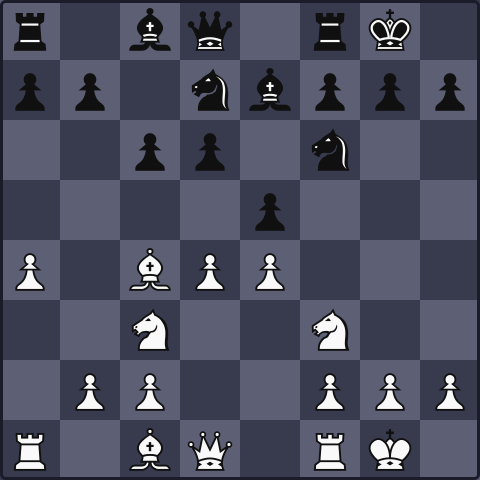
Philidor Defense C41
Solid development with ...d6
Hanham Variation
One of the oldest recorded chess openings. Black defends the e5 pawn with ...d6 instead of ...Nc6, keeping a solid but slightly passive structure. Named after the legendary 18th-century player François-André Danican Philidor.
The Philidor is a solid, classical defence that avoids the heavily analysed Spanish and Italian lines. Black keeps the position closed and waits for White to overextend. It is a favourite of players who want a safe, strategic option against 1.e4.
Lines
Hanham Variation
intermediate
1. e4 e5
2. Nf3 d6
3. d4 Nd7
4. Bc4 c6
5. Nc3 Be7
6. O-O Ngf6
7. a4 O-O
Black develops the knight to d7, keeping e5 defended. The Hanham Variation is the modern main line of the Philidor, leading to rich positional play with both sides having clear plans.
2. Nf3 d6
3. d4 Nd7
4. Bc4 c6
5. Nc3 Be7
6. O-O Ngf6
7. a4 O-O
Classical Philidor
intermediate
1. e4 e5
2. Nf3 d6
3. d4 exd4
4. Nxd4 Nf6
5. Nc3 Be7
6. Be2 O-O
7. O-O c5
8. Nf3 Nc6
Black releases the central tension early and develops naturally. White has a slight space advantage but Black's position is solid and without weaknesses.
2. Nf3 d6
3. d4 exd4
4. Nxd4 Nf6
5. Nc3 Be7
6. Be2 O-O
7. O-O c5
8. Nf3 Nc6
Philidor Counter-Gambit
advanced
1. e4 e5
2. Nf3 d6
3. d4 f5
4. dxe5 fxe4
5. Ng5 d5
6. e6 Nf6
7. Bc4 Bc5
8. Nf7 Qe7
9. Nxh8 Nc6
10. Bb5 g6
11. Bxc6+ bxc6
12. O-O
Black sacrifices central stability with an early ...f5, opening lines and creating tactical complications. A sharp, double-edged line that rewards aggressive play.
2. Nf3 d6
3. d4 f5
4. dxe5 fxe4
5. Ng5 d5
6. e6 Nf6
7. Bc4 Bc5
8. Nf7 Qe7
9. Nxh8 Nc6
10. Bb5 g6
11. Bxc6+ bxc6
12. O-O
Lopez Variation (4.Qxd4)
intermediate
1. e4 e5
2. Nf3 d6
3. d4 exd4
4. Qxd4 Bd7
5. Bd3 Nc6
6. Qe3 Nf6
7. Nc3 Be7
8. O-O O-O
Instead of recapturing with the knight, White uses the queen to recapture. This avoids some of the deepest Philidor theory and leads to positions where White's queen may later be a target.
2. Nf3 d6
3. d4 exd4
4. Qxd4 Bd7
5. Bd3 Nc6
6. Qe3 Nf6
7. Nc3 Be7
8. O-O O-O
Antoshin Variation (4...g6)
intermediate
1. e4 e5
2. Nf3 d6
3. d4 exd4
4. Nxd4 g6
5. Nc3 Bg7
6. Be3 Nf6
7. Be2 O-O
8. O-O Nc6
Black fianchettoes the king's bishop instead of developing to e7. The Antoshin Variation leads to positions resembling a KID or Modern setup, with the g7 bishop putting pressure on the long diagonal.
2. Nf3 d6
3. d4 exd4
4. Nxd4 g6
5. Nc3 Bg7
6. Be3 Nf6
7. Be2 O-O
8. O-O Nc6