← All Openings
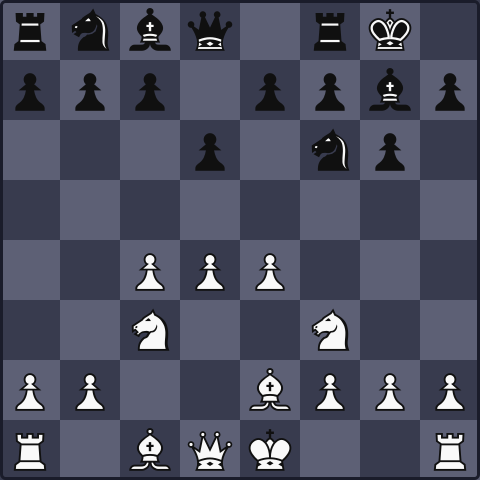
King's Indian Defense E60–E99
Dynamic counterattacking system
Classical Variation
Black allows White to build a big pawn centre then attacks it with piece pressure and the ...e5 pawn break. One of the most complex and dynamic defences against 1.d4.
The King's Indian Defense is a dynamic, counterattacking system that offers Black excellent winning chances. Black allows White to build a massive centre and then attacks it with ...e5, leading to razor-sharp positions where one mistake can be fatal. For players who want to play for a win with Black.
Lines
Classical Variation
intermediate
1. d4 Nf6
2. c4 g6
3. Nc3 Bg7
4. e4 d6
5. Nf3 O-O
6. Be2
White builds a strong centre. Black fianchettoes the bishop and castles. The most principled and deeply theoretical King's Indian line.
2. c4 g6
3. Nc3 Bg7
4. e4 d6
5. Nf3 O-O
6. Be2
Sämisch Variation
advanced
1. d4 Nf6
2. c4 g6
3. Nc3 Bg7
4. e4 d6
5. f3
White plays f3 to support e4 and prepare a massive pawn advance. One of the most aggressive lines against the King's Indian.
2. c4 g6
3. Nc3 Bg7
4. e4 d6
5. f3
Four Pawns Attack
advanced
1. d4 Nf6
2. c4 g6
3. Nc3 Bg7
4. e4 d6
5. f4
White occupies four central squares with pawns. A positionally ambitious approach that also carries the risk of overextension.
2. c4 g6
3. Nc3 Bg7
4. e4 d6
5. f4
Fianchetto Variation
intermediate
1. d4 Nf6
2. c4 g6
3. Nf3 Bg7
4. g3 O-O
5. Bg2 d6
6. O-O Nc6
White employs a kingside fianchetto instead of the Classical e4 setup. This variation avoids the sharpest KID theory and leads to more positional, manoeuvring play.
2. c4 g6
3. Nf3 Bg7
4. g3 O-O
5. Bg2 d6
6. O-O Nc6
Bayonet Attack
advanced
1. d4 Nf6
2. c4 g6
3. Nc3 Bg7
4. e4 d6
5. Nf3 O-O
6. Be2 e5
7. d5 Nbd7
8. b4
In the classical KID structure, White launches a queenside advance with b4 before Black can mount a full kingside attack. One of the sharpest and most critical KID lines.
2. c4 g6
3. Nc3 Bg7
4. e4 d6
5. Nf3 O-O
6. Be2 e5
7. d5 Nbd7
8. b4