← All Openings
King's Gambit C30–C39
The original attacking opening
King's Gambit Accepted
White sacrifices the f-pawn on move 2 to gain rapid development and a strong centre. One of the oldest and most romantic openings - aggressive and full of tactical complications.
The King's Gambit is the ultimate attacking opening. White sacrifices a pawn for lightning-fast development and a direct assault on the king. It's the opening of the Romantic era - wild, tactical, and incredibly fun to play. Perfect for players who love chaos over quiet positional play.
Lines
King's Gambit Accepted
intermediate
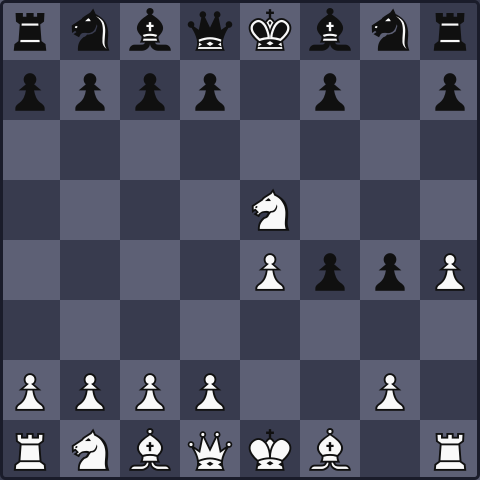
1. e4 e5
2. f4 exf4
3. Nf3 g5
4. h4 g4
5. Ne5
Black accepts the pawn and tries to hold it with ...g5. White plays h4 and the knight leaps to e5. One of the sharpest continuations in the Accepted.
2. f4 exf4
3. Nf3 g5
4. h4 g4
5. Ne5
King's Gambit Declined
intermediate
1. e4 e5
2. f4 Bc5
3. Nf3 d6
4. c3 Nf6
Black declines the gambit, developing actively with ...Bc5. White continues normally with c3 and d4. A solid and principled response.
2. f4 Bc5
3. Nf3 d6
4. c3 Nf6
Falkbeer Counter-Gambit
intermediate
1. e4 e5
2. f4 d5
3. exd5 e4
Instead of accepting or declining normally, Black counter-gambits with 2…d5. Black sacrifices a pawn for central space and active piece play.
2. f4 d5
3. exd5 e4
Bishop's Gambit
intermediate
1. e4 e5
2. f4 exf4
3. Bc4 Nf6
4. Nc3 c6
5. Qf3 d5
6. exd5+ Be7
Instead of the knight to f3, White develops the bishop to c4 immediately. An old and aggressive line that keeps the f3 square open for the queen.
2. f4 exf4
3. Bc4 Nf6
4. Nc3 c6
5. Qf3 d5
6. exd5+ Be7